 They say some things are so addictive you can get hooked on your very first try. Patrick Jeannette (aka “Grampy Pat”) had this experience the first time he sampled a true Alaskan sourdough bread, and he’s had nary a sourdough-free day since.
Growing up in the Los Angeles area, Grampy Pat learned to cook beans, tacos, enchiladas, and Mexican rice from his Mexican-American father. The eldest of 6 children, Grampy Pat was the official babysitter and ad hoc parent when his mother and father needed to “get away from the brood,” he says. But Grampy Pat had never really baked anything until he was 17 and his father died, leaving him as the main supporter in the household for his stay-at-home mother and 5 siblings. Still, the “baking” was just Bridgford frozen par-baked breads–a far cry from the gorgeous hand-shaped baguettes, boules, and miches he would later pull hot from his oven.
 Still, many years passed between those Bridgford rolls and Grampy Pat’s signature sourdoughs–years that Grampy Pat spent, in his wife’s words, as a “serial entrepreneur.” Life moved at a fast pace in the 70s, says Grampy Pat, and after a couple of failed ventures a successful printing business allowed him to “buy the big house on the hill for my wife and 2 kids,” before migrating north to Alaska to use his design minor to create fabulous kitchens for affluent Alaskans. When Grampy Pat had completed a kitchen, he always cooked the first meal in it for his clients. One night a client said “That’s great–you cook dinner and I’ll bake Alaskan sourdough bread to go with it.”
Well, “OMG,” says Grampy Pat, “for me that first dinner was all about the bread!” The client used a sourdough starter that fed gold miners in 1878 in Ketchikan, AK. He gave Grampy Pat some of the starter and wrote the recipe on the inside of a paper bag, quite possibly unaware that he was unleashing a culinary tornado of leavened bread potential on not only Seward’s Folly but on the rest of the continental United States as well.
A passion was born. “A few weeks later I was holding seminars on baking Alaskan sourdough,” says Grampy Pat.
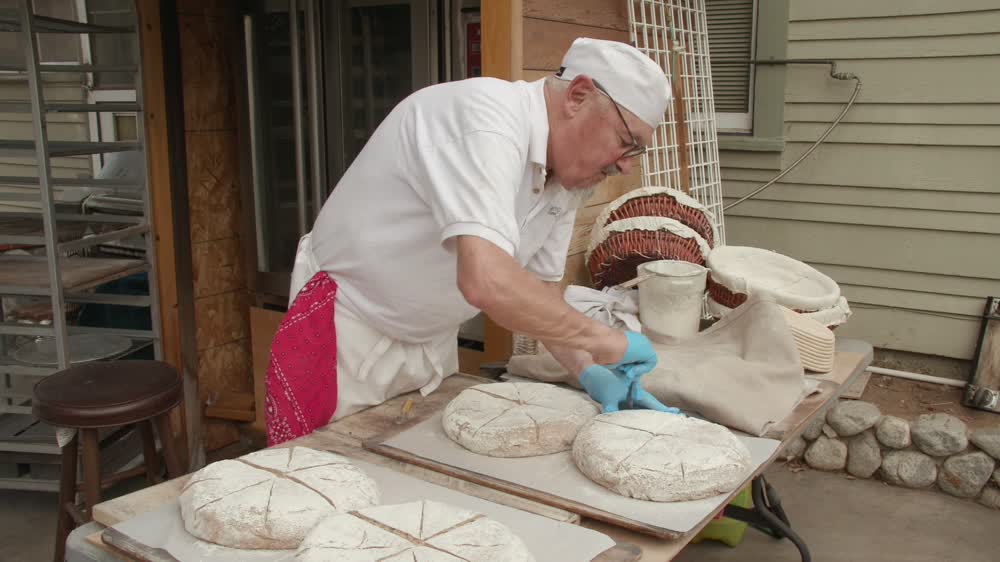
Grampy Pat eventually moved back to California and baked for family events and friends. Forever the entrepreneur, he had 3 different businesses going when one day his next door neighbor asked if he could bake her 14 baguettes. “Yes,” he said, “but I only bake naturally leavened sourdough breads, nothing with commercial yeast.” This was not a problem for the neighbor, nor was it a problem for Grampy Pat that he had never shaped or baked a baguette. “I went on YouTube to learn how,” he says, baby boomer in age but millennial in spirit.
Grampy Pat was working by day and baking by night when his wife, now Dean of the College of Arts at California State University, Long Beach, told him “Honey, I can’t sleep with you banging around and baking bread in the middle of the night.” So Grampy Pat quit his day job and started baking in his home, after securing licensing that made him legal and an oven that allowed him to bake 48 loaves of bread at a time. He also acquired a name for his bakery: GrampyPat’s (almost famous) Sourdough Bread, after his grandson said “Grampy Pat, why don’t you start a bakery and call it Grampy Pat’s almost-famous sourdough because someday you’ll be famous.”
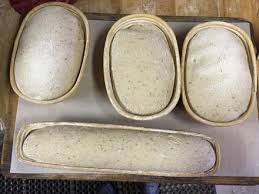 Grampy Pat still uses that 130-year-old Alaskan sourdough starter for all of his breads. He began baking for restaurants and breweries, as well as selling at the Orange Home Grown Farmers & Artisans Market, at which–judging by online comments–Grampy Pat has achieved at least a modest level of notoriety, if not outright fame.
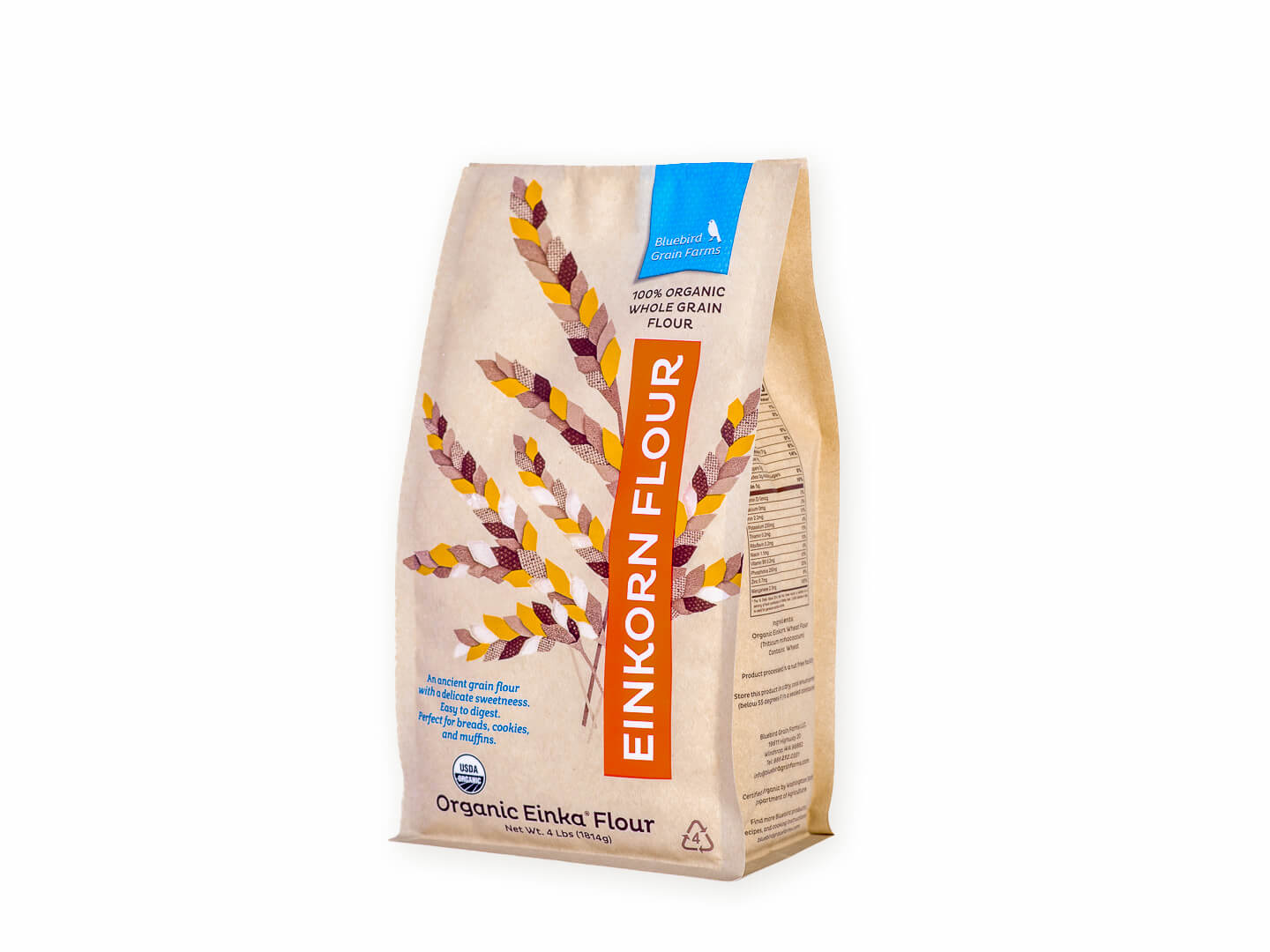
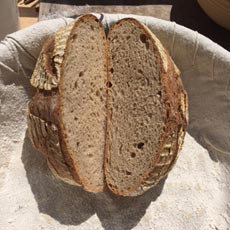
It’s a well-deserved reputation, built on the taste, texture, and quality of Grampy Pat’s breads. He creates only 100% organic breads made with high alkalinity water and ancient fiber-rich freshly milled grains. “Enter Bluebird Grain Farms,” says Grampy Pat. He uses Bluebird’s Organic Einkorn Flour in his Einka Sourdough, noting that these breads go through a 48-hour fermentation period. “The longer the fermentation, the healthier naturally,” says Grampy Pat. “It’s baking like our forefathers did; they couldn’t go to a convenience store and buy yeast.”
Indeed, not only does Grampy Pat not buy his yeast at grocery stores, but he doesn’t buy his flours there either. That’s why he says that Bluebird’s reliable shipping process is critical to his success. “Their bread flours are fresh-milled and dependable,” he says, “and I always receive my orders in a timely fashion.”
Grampy Pat admits to a more health-conscious approach the older he gets. It’s why he values the 48-hour fermentation, why he likes Einkorn Flour (what’s not to like about a low-gluten flour that’s rich in protein, phosphorous, vitamin B6, potassium, antioxidants and amino acids?), and why he uses sprouted wheat flour in other breads. (Ok, so maybe his Wine Flour Sourdough with Chocolate Nibs isn’t at the top of the list for a weight loss diet–especially when you can’t help but eat the whole loaf yourself–but if you’re going to eat Wine Flour Sourdough with Chocolate Nibs, you won’t find a more nutritious version than Grampy Pat’s.)
Grampy Pat’s offerings read almost like a full menu: pretzels with mustard seeds marinate in unripe sour grape juice for starters; warm up with sourdough spelt, rye, or whole chili sourdough; cleanse the palate with gluten-free bread before moving on to Asiago cheese sourdough or true Italian biga ciabatta; sourdough baguettes for the main course; and finish with the aforementioned chocolate wine flour bread. For a moment there you could believe that you weren’t just eating a 6-course bread meal.
 A few years ago Grampy Pat got the opportunity to bake in a 17th-Century wood-fired oven in Cortona, Italy. It’s a bit of an “Under the Tuscan Sun” memory for Grampy Pat: fresh Italian Asiago cheese, an aged Borolo wine opened the day prior, 16 loaves baked in the village oven, his wife, and friends, in a villa near an olive grove. “It was incredible!” says Grampy Pat, (only he added an expletive before “incredible” for emphasis). “Stupefacente!” the Italians might say. “Amazing!” Read more here about this experience.
Although Grampy Pat’s bread is best enjoyed fresh from the farmers market, those of us out of reach of Orange County, CA, can still experience the flavors and texture of his sourdoughs through shipping channels. “I ship internationally and stateside,” says Grampy Pat. Sourdough is a natural preservative, so Grampy Pat’s breads will last up to two weeks, as long as it’s not too hot, so order away.
In a celebrity-filled place like Los Angeles, fame can be fleeting. But like his 1878 Ketchikan sourdough starter, Grampy Pat is in this baking business for the long haul.
Learn more about Grampy Pat’s (almost famous) Sourdough Bread by visiting his website.

 love of geology with a job in Alaska. Best of luck Kevin, and thanks for all your hard work! If you or anyone you know is interested, you can review the full position description
  For
For 
 Missy is such an advocate of Bluebird’s grains that she says “We wouldn’t even do a whole grain bread if we didn’t have Bluebird flours.” She continues, “You can taste the difference. It’s very obvious. You use a whole grain flour from somewhere else and it just tastes dead; Bluebird’s flours are fresh and lively. You can’t compare anything else to Bluebird.” Missy notes that the Mazama Store sells a lot of whole grain bread, all of which is made using Bluebird flour. “People really look forward to it and reserve it ahead of time,” she says. “We truly feel that using Bluebird products makes a difference to our customers.”
 Missy continues, “I want my employees to have the best pay they can get. We want to keep them; they’re part of our family.” But she acknowledges, “It’s still so hard to make a small business pencil out. We are constantly working to keep the business profitable while paying our employees a living wage.” This concern feeds into what Missy refers to as “the 3 prongs of sustainability”: longevity of the employees, longevity of the business, and longevity of the planet. To address planetary issues, the Mazama Store has taken a close look at the waste it generates. “We look at how things come to us and we try to minimize packaging,” says Missy. “When you own a store you really see how things arrive. We make many ordering decisions based on not just the quality of the product, but also the amount of packaging involved.”
 Where the store has really been able to make a difference is its approach to food waste. First of all, employees strive to minimize, if not eliminate, true food waste. “We are very creative,” says Missy. “With the bulk items, we don’t like to let them sit in the bins too long before we incorporate them into the kitchen. Same with produce–we only want the freshest things out in the store, then we take the older items back into the kitchen to be made into soups. Fruit is made into pies, or apple butter, pear butter, or pastries.” It’s the reason there is no published menu at the Mazama Store; the kitchen needs to have the creative freedom to look at what needs to be used and design menu items around those ingredients. Food scraps are composted by locals who pick up buckets of food waste; someone else picks up leftover milk from the espresso machine and feeds it to her pigs. “It’s very rare that we throw anything out,” says Missy.
 The Mazama Store gracefully dances the line between folksy and sophisticated, with a carefully curated selection of clothing, mugs, glassware, gifts, and toys augmenting food offerings that would rival those in a chic urban market. Both the store’s shelves and its website promote the work of
  For the LeDucs, the Mazama Store is truly a family business, with Rick, Missy, and their 4 children all working at the store at various points. Although their youngest daughter, Sylvie, is in China, the other 3 LeDuc adult children all work at the store, as well as being involved in the community. Missy manages to find a balance between home life and work life by getting outside whenever possible, and taking little trips out of the valley with Rick here and there. (“Although when we travel I am always looking at other general stores, getting new ideas,” she admits.) But much of Missy’s energy is derived not from being away from the store, but from being right in the thick of it. “I have to put a lot of time into the store,” Missy says. “It’s like an organism that’s changing and growing. I need that, otherwise I wouldn’t enjoy it.”
 Missy says that customers, too, feed her energy. “We have really wonderful customers,” she says. “We have our locals who we know and love, who come in to visit and talk about things weighty and trivial. And then we have our part-time customers. The part-timers work really hard in their other lives to be able to come here, so when they’re in Mazama they’re in a really good mood. They want to say hello at the store, they want to enjoy the outdoors.” She continues, “We don’t seem to be just a convenience store for the part-timers. They know our employees by name. They want to get to know the locals. It’s really special for me to watch.”
 Missy appreciates the Mazama Store’s customers in the bigger picture as well, because they are choosing to support a family-owned independent business. “In this world of WalMart, Amazon, and Costco,” she says, “you need to value your small businesses. If you don’t actually physically go and support them, they will disappear. New laws don’t favor small businesses. You need to go to your local store, get to know the people there, and support them.” This is no selfish request, motivated by personal gain. Missy reminds us that small businesses like the Mazama Store allow employees to earn a living locally. “These small businesses are supporting the people in our community,” she says. “Our employees–this is our community. We’ve seen other places where small businesses close and people have to move out of the community to find work. We see it back east. To me this is a big blinking red light–you need to cruise your towns and support your local stores.”
 We are excited to announce our new fruit syrup supplier Hidden Acres Orchard. They are a family owned and operated orchard located just north of Spokane in beautiful Green Bluff, WA. If you happen to be traveling nearby, they have great U-pick fruit options throughout the growing season- give them a call at 509-238-2830 for more
 offering their
 The transition from political scientist to executive chef was an evolution–one that confirmed Molitor’s eventual career path. “I learned a lot about myself over those couple of years,” he says. “I realized that my future belonged in restaurants.”
 Molitor says “the v
 and their landscape. We love the work they do- they are preparing the next generation of farmers, environmental stewards, and leaders! Bluebird has been helping CiB by plowing and cover cropping the field where their 2018 garden expansion is planned. Stay tuned for more developments.
 Our annual Granary Open House and Tour is coming up on Saturday December 9th from 10:00 AM- 1:00 PM (tour at 12:00). Come on up and share a hot drink, meet your local farmers, and learn how we store, clean, mill, and package our organic grains. You’ll get to see our unique wooden silos that help naturally condition the grain and our cool old-school grain cleaning machinery. We’ll have Bluebird products and our gift baskets for sale if you need to do some last minute holiday shopping. Call 509-996-3526 for directions and to RSVP.



 been working to find a trusted supplier for our grains in the Spokane area, and they’ve come through for us. If you’re an eastern Washington resident, be sure to check out this excellent grocery chain.
 On a foggy day last February after skiing the Echo Ridge Loppett, my kids and I stopped at the
  Brooke and Sam Lucy of
  Bluebird is just the tip of Lindsay’s efforts to source local ingredients. Local and regional growers and farmers provide her with seasonal fresh fruit and vegetables. Her own parents’ home garden in Chelan sends fresh herbs, kale, cherry tomatoes, zucchini, raspberries, and other produce straight into the bakery. Blueberries for pies and pastries come from
  at the bakery are things that feature fresh, locally-grown, in-season fruit,” Lindsay says. “This includes our fruit Danish [nectarines, peaches, or raspberries], fruit pies [cherry and strawberry-rhubarb are particular favorites], and our cherry almond tart.”
 The bakery is also a place where Lindsay’s love of baking is evident in every product in the cases. Lindsay says, “I’ve always loved to bake for my family and baking for my community members is an extension of that. I get satisfaction knowing that my treats are part of an enjoyable experience for locals and visitors alike.”
 For more information about Lake Chelan Artisan Bakery,
  awesome organization to help grow our local Northwest food economy.


 The Mitchells’ yin/yang skill set enabled them to hit the ground running when they took over the bakery. “We just dived right in,” says Teresa. Although Teresa’s background is in education, she was no stranger to the culinary world, and even owned a small business selling her own spice blends. In contrast, Steve has experience at every level of business, from manufacturing to retail sales. Their diverse but complementary backgrounds led them to the division of responsibility they currently enjoy at the bakery. Teresa manages the ordering, the baking, the books, the menu creation, and human resources, while Steve takes care of the front of the house, the equipment, and the building infrastructure.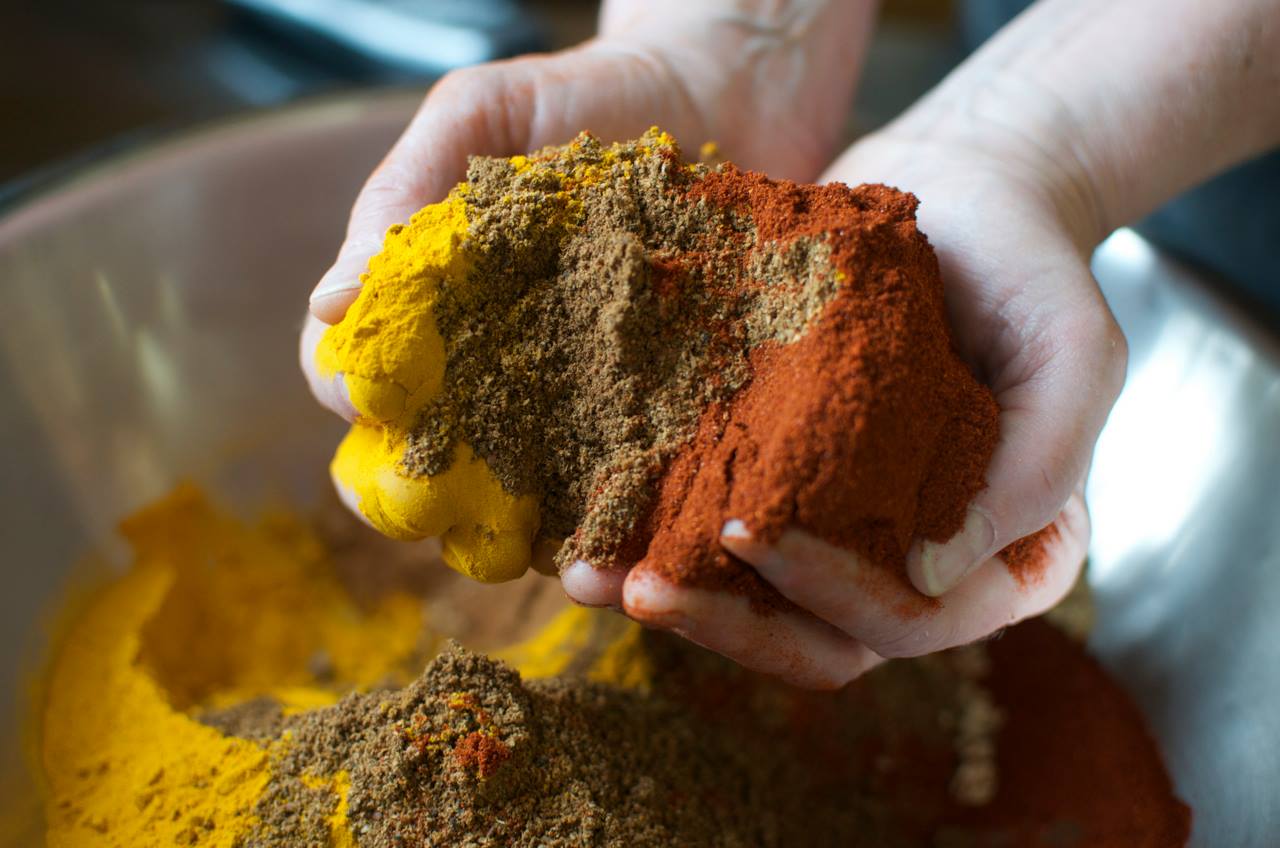
 Although Teresa is the chief baker in the family, Steve’s influence on the menu is apparent in the whoopie pies, whose origins, like Steve’s, are in New England. “We even import the fluff filling from New England,” Teresa says.
 The bakery has been somewhat of a family venture over the years, with the Mitchell’s oldest, Kavi, working at the bakery counter since he was 14 and his younger sister, Neela, helping with big events and some of the artistic aesthetic of the space. Still, despite the year-round demands of the bakery, the Mitchells get out on fantastic trips with their kids. “We prioritize travel,” says Teresa. “Our kids [both adopted from India] are products of the world, and we want to expose them to the great wide world and different ways of living.” Teresa expresses gratitude that through international travel, her kids have cultivated a passion for art and culture.
 Farmer Sam has also been busy helping
 Washington Pass